Field map — Millbrook night lighting
- type
- map
Research map · Collection log · Night lighting audit
What a town actually controls about its night sky, and what one council can change first. Scope: street lighting in a fictional small town called Millbrook. Out of scope: road-safety engineering, astronomy instrumentation and the private forecourts the council cannot reach.
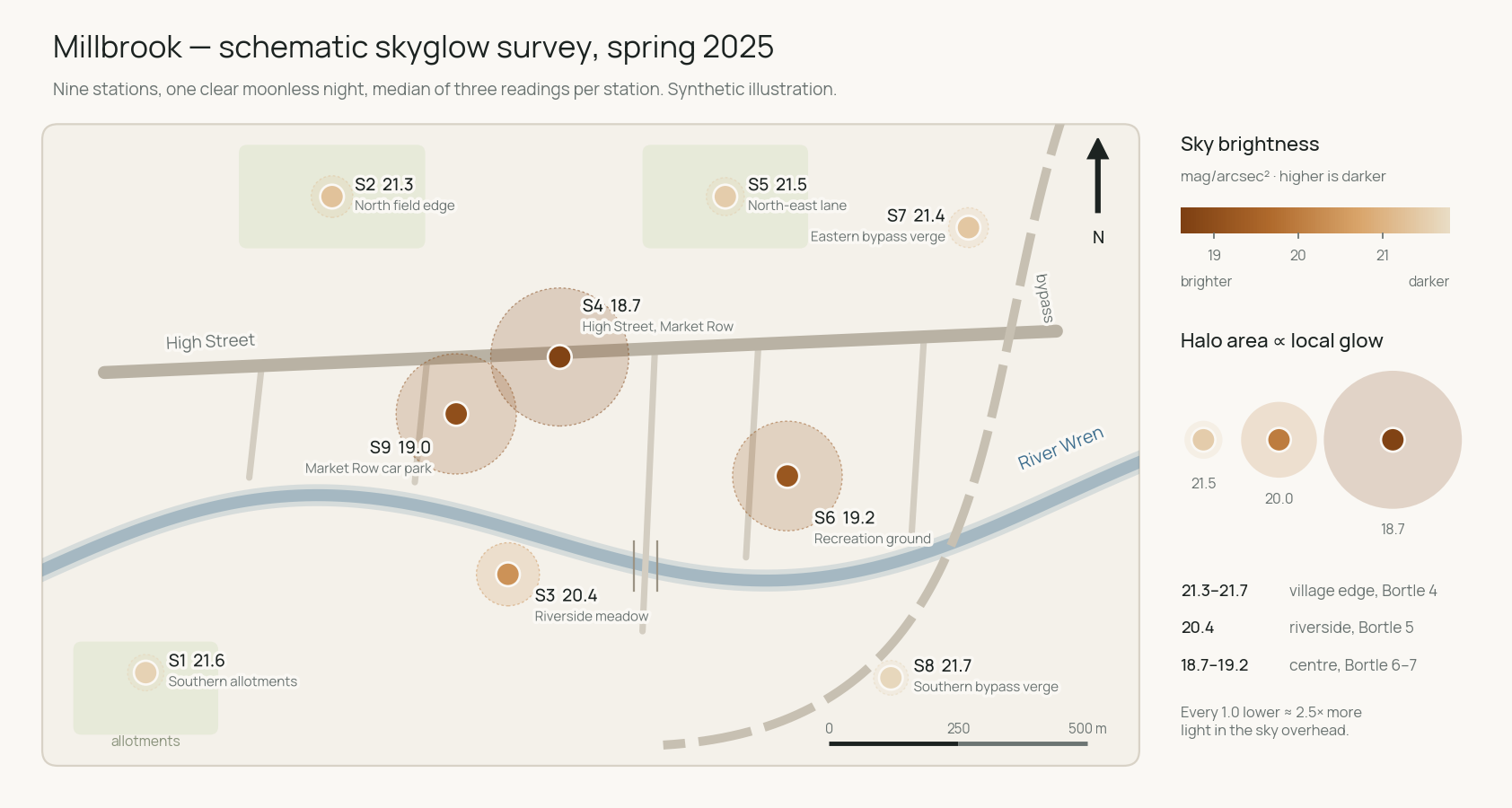
Synthetic schematic of the spring 2025 survey. Halo area and colour follow local glow; readings are in mag/arcsec². The full table is in the survey source.
The short answer
- Audit before ordering. 31 of 214 fittings have no recorded type, so no one can say what would be replaced. Run the audit first; it costs staff time, not capital.
- Take the free wins. Full cut-off compliance and the lumen budget are already policy. A straight replacement of 2,400 lm lamps with 1,850 lm fittings cuts installed flux by about 23% on that row, with no new decision.
- Treat colour and dimming as experiments. The 2200 K pilot is supported by one thin, independent trial; part-night dimming is supported by the tariff, not by residents or the police. Both need criteria before they run, not after.
What this map does not say: that 2200 K is settled, that dimming is safe, or that the council can compel the petrol station to change. Those are open questions below.
Key terms
- Skyglow — atmosphere-scattered light brightening the whole sky. Measured here at 18.7–21.7 mag/arcsec² across nine stations.
- Light trespass — light falling where it is not wanted. The worst reports are private forecourts, outside the policy.
- Glare — light that reduces what you can see. Residents' main complaint; no measurement exists yet.
- Correlated colour temperature — a kelvin summary of warm or cool white. This is the 2200 K vs 3000 K argument.
- Full cut-off — no light emitted above the horizontal. Already policy; compliance is the gap.
- Part-night dimming — reduced output for part of the night. The tariff pays for it; a mandate is absent.
- Lumen budget — a cap on total flux per area. The cheapest measurable reduction available.
- Bortle scale — nine-class naked-eye sky quality. Shared language, too coarse for proof.
The main sources
- Millbrook street lighting policy 2024 — FCO, a 3000 K ceiling, dimming permitted, lumen caps. Limit: binds council lamps only; the inventory is incomplete.
- Dark-sky survey, spring 2025 — the local baseline at nine stations. Limit: one night, uncalibrated meters.
- Lumen and Loom Aria data sheet — product claims for the pilot fitting. Limit: manufacturer only; no independent photometry.
- Wren Valley moth trial — lower CCT, less attraction at equal lumens. Limit: one site, one season, moths only.
- Council minutes, 4 March 2025 — the pilot is authorised, its criteria are not. Limit: no vote on dimming or colour.
- Wessex Grid dimming tariff — dimming earns 6%; switch-off earns nothing. Limit: a three-year controller commitment.
- Resident night-walk interviews — what people notice: dark corners and glare. Limit: six self-selected people.
- National dark-sky advisory note — independent direction and evidence warnings. Limit: guidance, not a standard.
Where the evidence points the same way
- Lower CCT and full cut-off are endorsed by both the independent advisory note and the council's own policy.
- The survey and the interviews agree that Market Row and the car park are the bright, glaring places.
- Everyone with a financial interest in dimming (Wessex Grid) or a technical one (Ada Fenwick) prefers it to switch-off.
What is contested
- Colour. The moth trial supports 2200 K; three volunteers and twelve nights is a thin base for a town standard. The council's own ceiling is 3000 K.
- Dimming. The tariff rewards it, but the interviews show people already avoid unlit corners, and the police have not been asked.
- Reach. The strongest glare source is private. The policy's forecourt clause has no enforcement route that this map can verify.
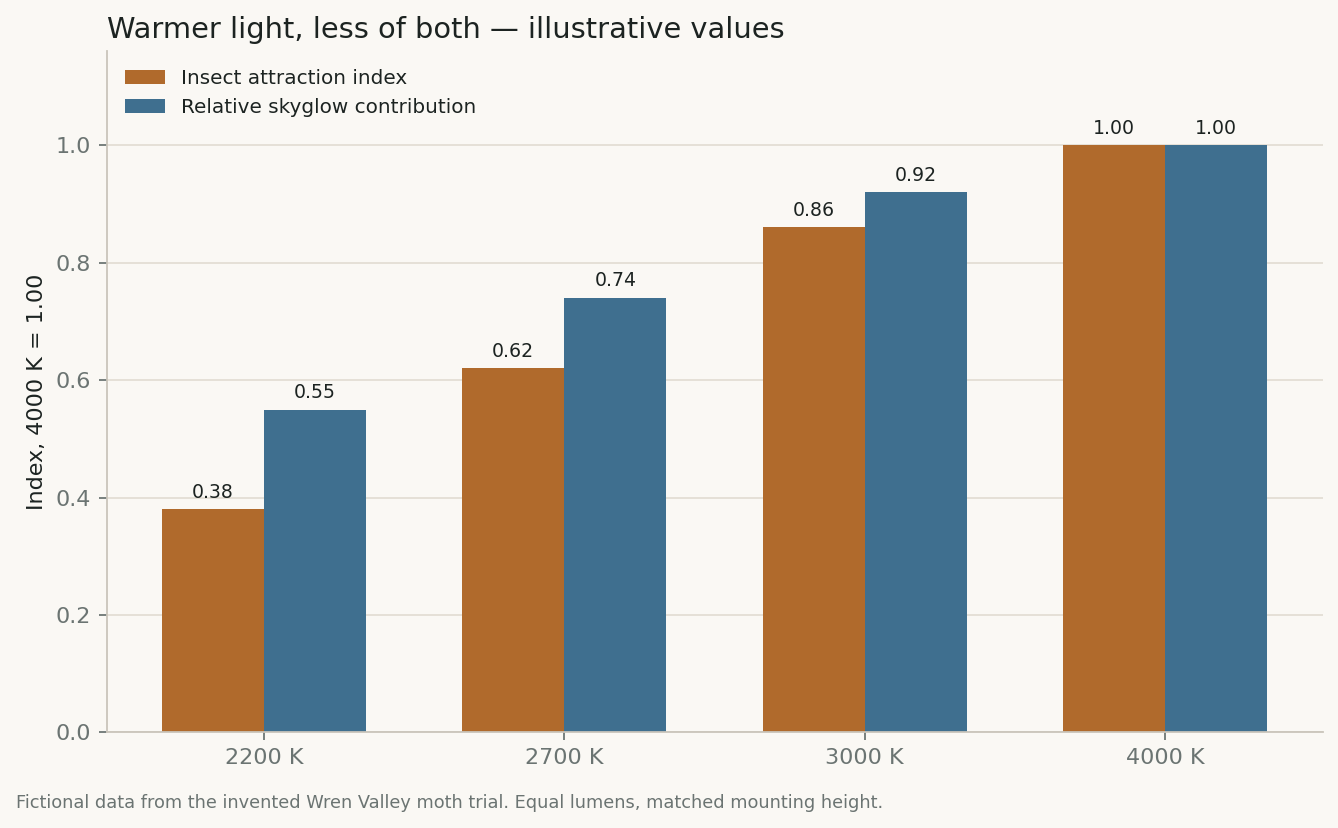
Illustrative values from the invented Wren Valley trial, at equal lumens. Direction only: one site, one season.
Open questions
- Does 2200 K reduce insect attraction enough to standardise? — investigating. Settles when a second independent trial agrees and a local repeat confirms it.
- Is part-night dimming acceptable on the high street? — open. Settles when a twelve-month pilot, a representative survey and a police position exist.
- Which baseline measurement should Millbrook adopt? — investigating. Settles when one method is written into policy and the same nine stations are repeated.
- Can the council require shielded fixtures on private forecourts? — open. Settles when written legal or planning advice establishes a route and one precedent is recorded.
- What does a first-year retrofit cost over ten years? — investigating. Settles when purchase, installation, energy and replacement costs are totalled on one basis.
- Does the Bortle class improve measurably after a retrofit? — open. Settles with a pre-registered repeat at the same nine stations.
The playbook
Retrofit sequencing is the working procedure: audit, fix compliance on the normal cycle, pilot twelve lamps, measure brightness, glare and residents together, test the tariff, then decide. Night lighting audit is the first step in detail.
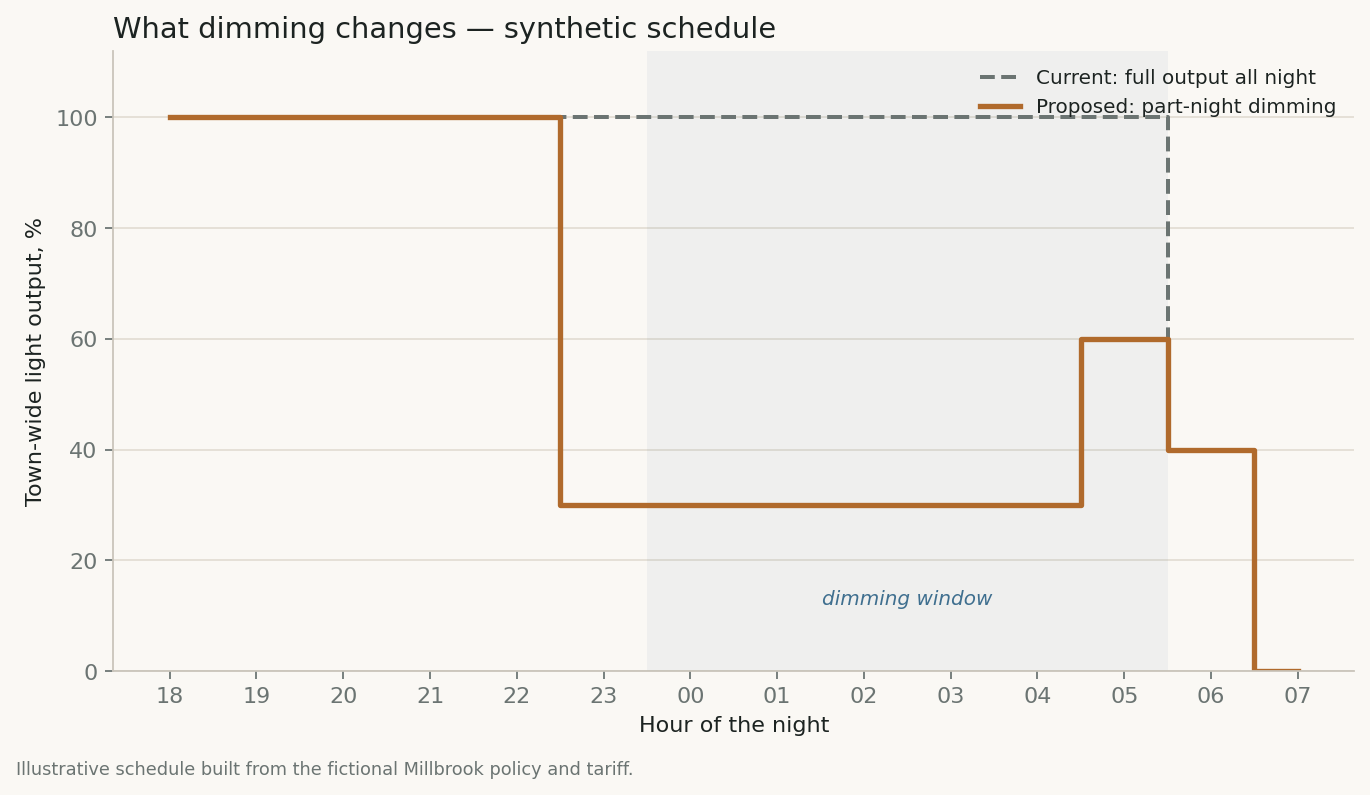
Synthetic schedule: 100% until 23:00, 30% until 05:00, 60% before dawn. Not an adopted plan.
Numbers this map can and cannot stand behind
| Figure | Value and confidence |
|---|---|
| Baseline sky brightness, nine stations | 18.7–21.7 mag/arcsec² — measured once, method recorded |
| Installed flux cut on Market Row | about 23% — arithmetic from two luminaire figures |
| Energy reduction under the tariff | 6% — supplier schedule, conditions apply |
| Moth attraction at 2200 K vs 4000 K | about 38% — one independent trial, thin |
| Ten-year retrofit cost | not established — price withheld, no maintenance data |
About this demo: Millbrook, its council, its residents, the manufacturer, the utility, the ecology group and every document above are fictional. The three figures are synthetic illustrations drawn for this demo, not photographs or measurements. No real person, organisation, place or product is described.