AI literacy reading corpus
- type
- map
Research map · Collection log · Reference set
What this is: a comparison of twelve fictional course outlines on everyday AI literacy, twelve invented readings and what the overlap actually shows. Not a ranking of courses or readings. All outlines, institutions and readings are invented for this demo.
Coverage first
Twelve outlines were attempted. Ten were counted: nine collected in full and one reconstructed from a course description. One sits behind an institutional login and one was not obtained at all. Missing documents are not empty syllabi, so the percentages below are shares of the ten counted, not of all twelve.
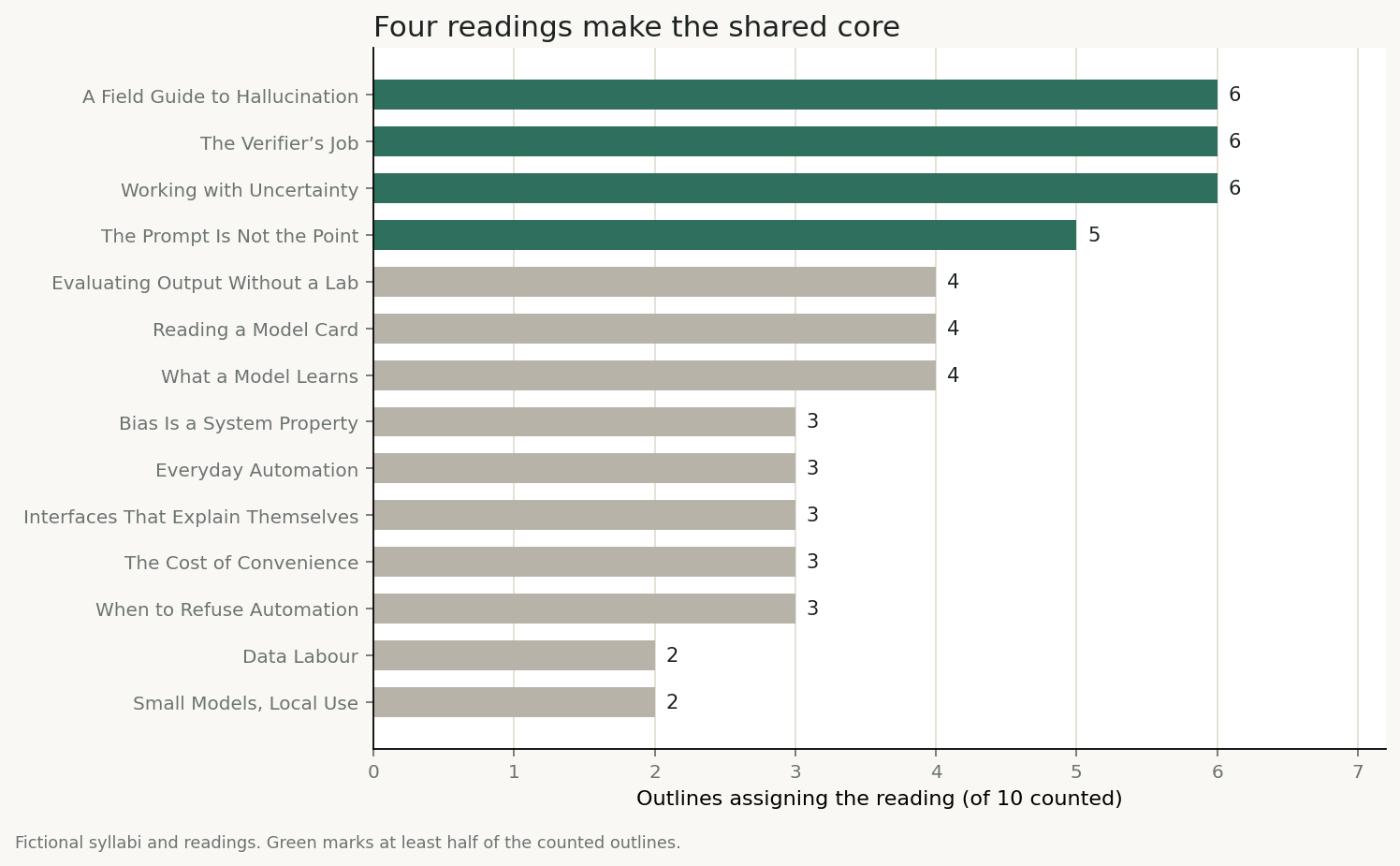
How often each invented reading appears in the ten counted outlines. Four clear at five or more; everything else at two to four.
The shared core
Four readings appear in at least half of the counted outlines:
- A Field Guide to Hallucination — 6 of 10.
- The Verifier’s Job — 6 of 10.
- Working with Uncertainty — 6 of 10.
- The Prompt Is Not the Point — 5 of 10.
Read together, they form a coherent emphasis: verify, tolerate uncertainty, and do not mistake prompting for the skill. That is a real pattern in this set. It is also an editorial pattern: one textbook could produce it, and this map has no publisher data.
The long middle
Surprisingly, no reading appears in only one outline. The set is more uniform than the course descriptions suggest:
- Four readings at four outlines: Evaluating Output Without a Lab, Reading a Model Card, What a Model Learns, Bias Is a System Property.
- Four at three: Everyday Automation, Interfaces That Explain Themselves, The Cost of Convenience, When to Refuse Automation.
- Two at two: Data Labour, Small Models, Local Use.
A reading in two outlines is not automatically weaker than one in five; frequency measures adoption, not usefulness.
What is missing
- Westmere Institute — AI Research Methods. Not obtained. If it has a methods reading, it is invisible here.
- St Anselm College — AI for Public Services. Behind a login. Its three readings are recorded but not counted; the checker flags that explicitly.
- Marsh Polytechnic — Prompting and Critique. Reconstructed from a course description, so chapter-level assignments may be missing.
- Concepts without readings. The outlines name procurement, accountability and public services, but almost no reading in the set addresses them. That is either a gap in the reading list or in my extraction; the map does not decide.
What to require, what to offer
Require: The Verifier’s Job and A Field Guide to Hallucination. They carry the shared core and are the least dependent on a particular course's framing.
Offer rather than require: Data Labour and Small Models, Local Use. Both appear twice, both broaden the economic and local-deployment angle, and neither is load-bearing for the core.
Investigate before adding: a public-services reading. The concept appears in the course descriptions but not in the assigned reading, which is exactly the kind of gap a corpus comparison is for.
Open questions
- Which readings belong in a shared core?
- Are the missing syllabi hiding unique readings?
- Is the reading set too narrow?
About this demo: twelve fictional institutions, outlines and readings. The counts come from the vault's own research-check run on 3 November 2026, not from real curricula. Exclusions are relative to the fourteen-item reference set, not a claim about what exists in the world.