Dossier — BRITA jug filters
- type
- map
What this is: a public-source claim audit of BRITA's household jug and cartridge filters, built from BRITA's own pages, the jug manual, a consumer-test account, a peer-reviewed pitcher-filter study and recycling pages. Not legal or buying advice, and not affiliated with BRITA. A verdict of "untested" or "no independent evidence" means the evidence was not found, not that the claim is false. Sources were accessed on 3 November 2026.
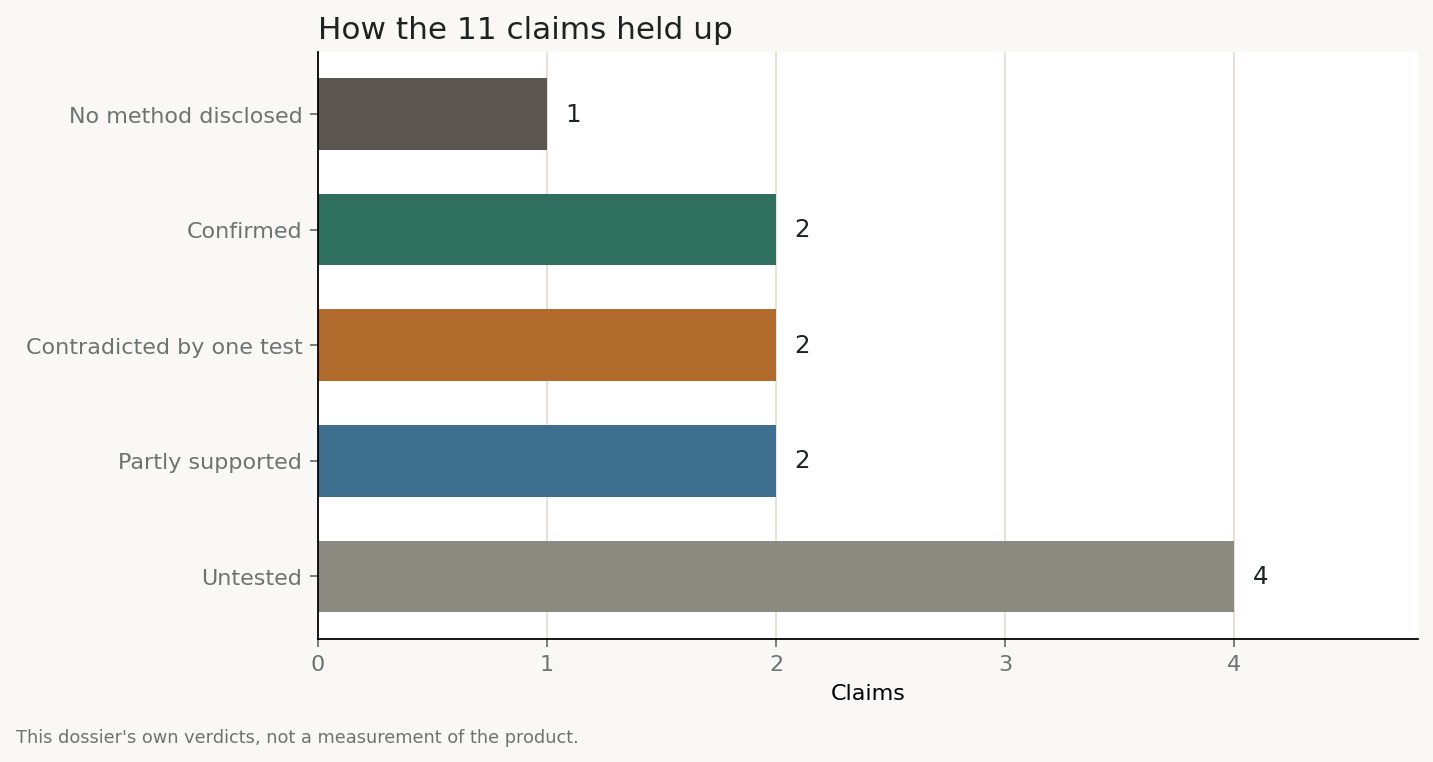
This dossier's own verdicts on 11 claims. A reading aid, not a measurement of the product.
The claims, at a glance
| Claim | Verdict and confidence |
|---|---|
| Reduces chlorine taste and odour | Partly supported · medium |
| Reduces hardness and limescale over the cartridge life | Contradicted by one test, second-hand · medium |
| Reduces PFAS by 98–99% | Untested for this model · medium |
| Reduces heavy metals such as lead and copper | Untested · low |
| Reduces pesticides, herbicides and pharmaceuticals | Untested · low |
| Cartridge life of four weeks or 150 litres | Contradicted by one test, second-hand · medium |
| Makes tea and coffee taste better | Untested and subjective · low |
| Limescale Expert is 50% more effective | No method or independent evidence · low |
| Jugs are made of BPA-free plastic | Confirmed · high |
| Uses ISCC PLUS certified bio-based plastic | Supported by certification · medium |
| Using the jug saves plastic and carbon | Partly supported, conditional · medium |
What the evidence supports
- BPA-free plastic. Which? describes the jugs as BPA-free thermoplastic, and EU food-contact rules already restrict BPA. True, but not a differentiator.
- Certified bio-based plastic. The ISCC PLUS claim is credible if the certificate is current. The scheme tracks certified material share, not filtration.
- Chlorine removal, direction only. Activated carbon removing chlorine is chemically sound and the manual cites a standard, but no independent tap-water test was found.
Where the evidence is thin
- Cartridge life. One secondary account of a German test says softening failed at about 25% of rated capacity. If it holds, the practical life is far shorter than "four weeks or 150 litres".
- PFAS. BRITA's UK and Australian pages say 98% and 99%; a 2024 study of different Brita models found 36–48%. Neither number describes MAXTRA PRO, which is the problem.
- Heavy metals and trace organics. The standards are cited, but no public test report for this cartridge was found.
- The 50% limescale comparison. No test method is published, so the percentage cannot be checked.
Source quality
This is the part a reader should weigh most. The two negative performance findings rest on a secondary news account of a paywalled German test; the PFAS evidence comes from US models, not MAXTRA PRO; and Which?'s full results are behind a paywall. BRITA's own pages are precise about standards but publish no certificates or batch reports. The dossier keeps those limits in every claim note rather than averaging them away.
Questions to ask BRITA
- Does MAXTRA PRO remove PFAS at the claimed rate?
- How long does hardness reduction actually last?
- Is the 150-litre life claim valid in soft and hard water?
- Is cartridge recycling available everywhere BRITA sells?
- What does the 50% limescale claim compare?
About this demo
Created for this Workroom demo from public pages and published studies, with URLs in every source note. BRITA is named as the subject because that is what the owner asked to audit. The dossier is not affiliated with or endorsed by BRITA, is not legal or buying advice, and should be checked against the original test reports before anyone repeats a verdict in public.