Biography — Mira Vale
- type
- map
- privacy
- public fictional demo
A working life in seven episodes: field recordings around the Wren estuary in 1978, touring, the Barrow Lane studio from 1985, the disputed "night sessions", and teaching from 1996. Mira Vale is a fictional person. The archive, narrators, letters and photographs are invented for this demo; nothing here describes a real person or estate.
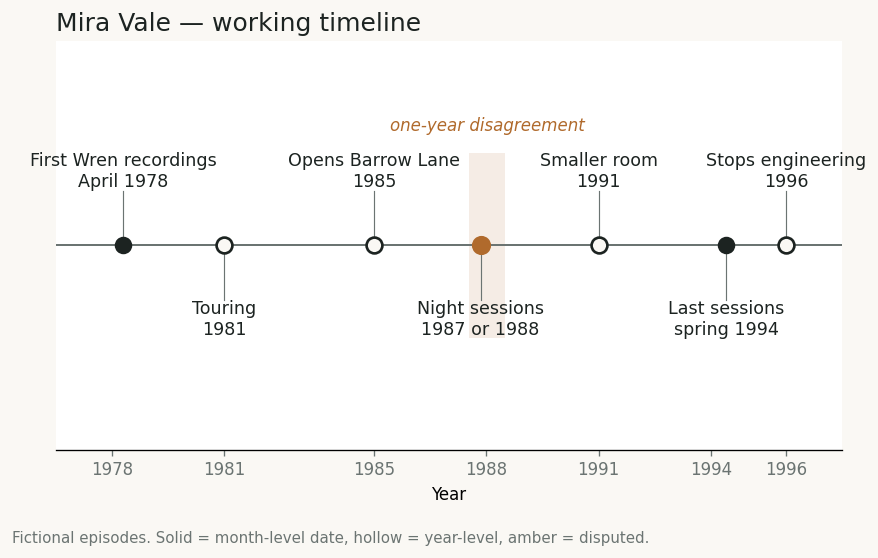
Seven episodes on one axis. Solid markers are month-level dates, hollow markers are year-level, and the shaded band is the one-year disagreement between Mira's account and Eli Mercer's.
The timeline
- First Wren estuary recordings — April 1978, month certainty. The reel box label and Mira's later interview agree; they may not be independent.
- Touring as a monitor engineer — 1981, year certainty. Only Mira's interview records it; the band is not named.
- Opens Barrow Lane Studios — 1985, year certainty. Both the interview and the archive agree.
- The night sessions — winter 1987 or 1988. The central disagreement: Mira says early 1988 and the reel label says "Night, 88"; Eli Mercer says the winter of 1987.
- Moves to a smaller room — 1991, year certainty. No reason is recorded.
- Last studio sessions — spring 1994, month certainty, from Eli's letter of 12 September 1994.
- Stops engineering and teaches — 1996, year certainty. Whether this was a choice or a fallback is disputed.
The artifacts
| Artifact | What it establishes, and its limit |
|---|---|
| Reel box labelled "Wren, Apr 78" | Dates the 1978 recordings — but the label is the donor's, not an independent record. |
| Notebook with microphone sketches | Shows the method before 1988 — undated, so it supports Eli's earlier dating without proving it. |
| Photograph of the control room | Shows the room after the 1991 move; the exposure date is not recorded. |
| Cassette interview with Mira Vale | The main direct account; 40 seconds are missing from side B. |
| Three letters from Eli Mercer | The closest contemporaneous account of the end; one side of the correspondence. |
Permission for every artifact is not recorded. The demo publishes them because they are invented; a real biography would keep them private until permission is evidenced.
Where the accounts disagree
- The year of the night sessions. Mira: early 1988. Reel label: "Night, 88". Eli: winter 1987. The notebook does not settle it, and the label may repeat Mira's memory. This is an open question.
- Why she stopped. Eli's 1995 letter describes a quiet studio; his 1996 interview says she had had enough of clients. The alternative — a deliberate move to teaching — cannot be excluded. See the question.
Interpretations on the table
- The 1978 recordings were an experiment in distance — proposed; the alternative is a paid commission.
- The night sessions changed her method — proposed; the alternative is that the method was already set by 1985.
- Teaching was a fallback when the studio wound down — proposed; the alternative is a deliberate change of work.
Each is labelled as an agent proposal. No human acceptance is recorded, and the alternatives are kept rather than merged.
What remains unknown
- The exact days of the 1978 recordings.
- The band Mira toured with in 1981.
- A dated session sheet for 1987–1988.
- Mira's replies to Eli Mercer's letters.
- Authentication of the letters and the reel label.
About this demo: Mira Vale, Eli Mercer, Barrow Lane Studios and every artifact are fictional. The biography is published with publish: true only because it describes an invented person. Its privacy and processing fields say "public fictional demo" and "local-only" so the boundary is explicit.